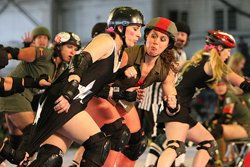


The other night I went to women’s roller derby. The Penn Jersey She
Devils were playing Canada’s Hammer City. I didn’t have a clue what
roller derby was, but I’d been intrigued to read in the local paper
that this was National Roller Derby Hall of Fame Weekend, and it was
being celebrated in the New Jersey town next to my own.
The game was held at the Mount Laurel International Sports Centre —
another surprise. I had no idea there was an international sports centre
so close to where I live. As it turns out, I had passed the
International Sports Centre many times without knowing it. It was that
warehouse-like building next to the strip mall where my allergist has
his office.
When I arrived at the International Sports Centre, there were about
50 roller derby fans waiting at the door. They were a lively group,
amply adorned with tattoos and piercings. Some of the older folk were
carrying folding chairs, and I learned, through friendly chitchat, that
there were no chairs or bleachers in the International Sports Centre.
You either brought your own chair or sat on the floor (in the latter
case, I was warned, “you’re liable to get a lapful of roller derby girl
— haha”). I went home to get a folding chair.
By the time I returned, things had gotten underway. The She Devils —
in red, white, and black T-shirts with little black skirts, many with
fishnet stockings under their knee pads — had a distinctly S&M
look. The Hammer City girls wore brown and white, some with gold
underpants. None of these girls were girls you’d want to mess with.
I found a place at the edge of the track (actually, a double
basketball court). There were a good number of babies and toddlers in
the group; tattoos notwithstanding, this was a family crowd. Around the
arena were posters advertising the sponsors: Dadz Bar and Grill of
Lumberton, New Jersey; Fat Kat Tattoo of Keyport, New Jersey; Unclaimed
Diamonds of Philadelphia; Bill Worrell’s Auto Body of Levittown,
Pennsylvania; etc.
I perused the program, which had a voluptuous roller derby girl,
with an American flag and an eagle by her side, sketched on the cover.
It explained that the Penn Jersey She Devils “are a proud member of the
Old School Derby Association (OSDA), a growing organization of women’s,
men’s, and co-ed leagues interested in playing Derby the way it could
be, would be, & should be.” The program continued, for the benefit
of those working on roller derby Ph.D.s: “Old School rules are a
melding between many of the current developments in Flat Track Derby
with the rules used by Old School Banked Track Roller Derby skaters.
These rules were developed by the Penn Jersey She Devils through
consultation with representatives from Derby teams from the 70s and we
believe add to a more exciting game for both the fans & the
players.”
Trey Sandusky was introduced to sing the Canadian and the U.S.
National anthems. Trey has a resonant baritone and sang both anthems
well. The program noted that he is known in the Flat Track Roller Derby
circuit as “Bobby Narco,” and has performed at Alice Tully Hall,
Carnegie Hall, and the Met. He is also in his 12th year in the Bronx
District Attorney’s office and has had stints in the violent crimes and
narcotics bureaus.
After the anthems were sung, Judy “the Polish Ace” Sowinski — the
She Devils’ coach and former member of the “legendary Eastern Warriors
Roller Derby team” — was introduced. Other members of that legendary
team were assembled on folding chairs in the VIP section. They would be
formally honored the next evening at the National Roller Derby Hall of
Fame Awards Presentation and Reunion Dinner at the Crowne Plaza Hotel
in Cherry Hill, New Jersey.
“Polish Ace” Sowinski explained the rules before the game got
underway. Both teams skate together as a pack, with the exception of
one skater from each team. These skaters have stars on their helmets
and are called jammers. When the first whistle blows the pack takes off
around the track. When the second whistle blows, the jammers take off
with the aim of breaking through the pack. The jammers score points for
each member of the opposing team they legally pass within the period of
a jam (which lasts no longer than two minutes). There are additional
nuances to the game, but that’s it in a nutshell.
To add to the proceedings, the girls go by pseudonyms. The She Devil
team, for example, featured such skaters as Lucky Luciano, Goody Two
Skates, Hard Licker, Tequila Sunrise, Pass a Fist, and Hot Rod Hussy.
Hammer City had Bashley Olson, Miss Carriage, Chainsaw Mary, and (my
favorite) Bitchslap Barbie. Given these names, the play-by-play
announcing is colorful.
There is a good deal of pushing and shoving in roller derby. To keep
this under control, the rules call for penalties for “vindictive
skaters,” but it’s a rough sport, and the jammers, in particular, must
be aggressive and resilient. As they approach the pack, teammates hold
out their hands to help swing them through; then, the jammers push and
weave to get to the front. Sometimes, there’s a pile-up. Lucky Luciano
(or was it Cherry Bomber?) was a big girl and when she fell, others
went down, cascading on top of her. Still, they all got up in a jiffy
and were skating again. That is, until the middle of the second period,
when one girl toppled and remained prostrate in her fishnets and
kneepads, unable to get up.
That’s when I left. There seemed to be no telling how long before
Miss Chievous (or was it Dirty Gert?) would be on her feet. An umpire
with spiked hair and multiple piercings had run out for ice packs, the
toddlers were wandering about and the babies passed around.
Fortunately, the She Devils were far enough ahead that I could assume
an American victory (though I confess to having developed a soft spot
for Danger Mouse, a spunky Canadian skater).
Contemplating Roller Derby afterwards, I realized that it’s a sport
with pathos. It doesn’t have much visibility, it doesn’t have affluent
fans, it doesn’t have fancy venues. But it does have lots of piss and
vinegar. All this seems a function of its origin. Roller Derby was
founded in 1935 in the depths of the Great Depression. As a sport, it
dramatizes the ethos of the 1930s. Jammers are the individualists who
make their way through the pack — that resistant mass that was
Depression America. The scrappy jammers need to be fast, tough, and
pugnacious, able to use their teammates when they can to swing them
through, but ultimately relying on themselves. James Cagney in Public Enemy and Paul Muni in Scarface
were “jammers,” as was Jean Harlow in most every movie she made. Joan
Crawford was a triumphant jammer — she pushed through and scored again
and again. Admittedly, Crawford wasn’t a very good mother, but what do
you expect when you’ve spent your life elbowing your way through a pack
of really tough, nasty girls, not to mention lecherous studio
executives?
The narrative of success in this country has become much fancier and
more complex than Roller Derby. I suppose it’s been replaced,
metaphorically, by football or maybe lacrosse. But it’s nice to know
you can still get a taste of a Depression sport, played by Old School
rules. And it’s nice to know there’s an International Sports Centre
right around the corner. • 14 November 2007