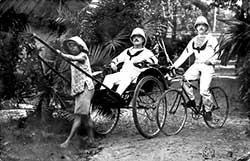


This story is an excerpt from the newly released King Cobra – Mekong Adventures in French Indochina
. The book is available now from DatAsia, Inc., in bookstores, and on Amazon.
Facing a discussion of French colonial policy, I find myself faltering. Generally when one discards the primitive belief that politicians are benefactors he becomes either a skeptic or a politician himself. Unfortunately, I am of the former class. However, it is apparent, even to the skeptic, that the French have a very efficient government in Indo-China; certainly as efficient as one could expect in an equatorial climate. Witness the regulation that makes it compulsory for every native who lives in or enters the country to have a card of identification bearing his photograph and finger-prints; this and many other thorough ordinances.

I know also that the government is divided in this manner; a Governor-General, a Governor of Cochin-China, a Resident Superior of Laos, of Cambodia, of Tonkin and of Annam; followed by numerous local residents, chiefs of cabinet, commissioners and delegates. And I know, too, that politics there is filled with the usual bribery and corruption which rusts political machinery everywhere. One of these rust-spots is visible in Saigon.
Go to the rue Paul Blanchy where a great tawny wall encloses the Régie d’Opium, and you will see it. Candor is a virtue of the French; for over the entrance a sign announces “Manufacture d’Opium.” Underneath, an arched gateway admits one past offices into a palm-grown court, around which are the various buildings where the opium is made and stored.
I visited the Régie d’Opium one early morning while the shadows of the palms were still cool in the quadrangle. A courteous French official conducted me to a large building facing the gate (a formidable structure with barred windows), prefacing the tour of inspection with the information that much of the poppy-juice came from Annam, Tonkin and Laos; while a great deal was sent from Yunnan; and some from India. It was impossible, he said, to raise enough in the country.
As he talked I could picture the raw treacle being pressed from the pistils of poppies; millions of white poppies that lay in spotless drifts throughout Asia. I could picture it being made into gummy balls like coconuts, covered with poppy-leaves and packed in bales; then shipped down to the coast by caravan, by coolie, by pirogue and steamer; there to be poured into the great reservoir of the Régie d’Opium.
Within the building the fumes nearly stifled me. In coils of steam, naked muscular torsos strained over copper pots, over troughs and great metal vats. A pallid vapor ascended to the dark beams that supported the roof.
We paused by a row of kettles, and my conductor explained that the process required three days. The raw opium was first steamed, and then stirred with wooden spatulas until it reached the consistency of dough; after this it was spread thinly in brass bowls and placed over ovens where the heat caused it to separate, and it was pulled off in tissue-like layers. The third stage was a matter of refining. The substance was put with water into deep receptacles and soaked for about twenty hours, during which time the impurities rose to the top and the opium settled in the bottom. Then it was filtered through pith (an ancient Chinese method) and the impurities boiled and re-filtered, so that not a drop would be wasted. After that it was placed in immense vats to boil again for many hours, thus removing the remaining water. Finally, it was poured into drums and stored for three or four months.
My guide informed me that the opium was kept in the upper story of another building until needed, then released from the drums into pipes which discharged it, with absolute accuracy, into boxes holding 100, 40, 20, 10 and 5 grams respectively. These boxes were then sent to the collector of customs, who sold the finished product to licensed dealers. One kilogram, he stated, was worth 180 piasters. And he added that from 80,000 to 100,000 kilograms were produced a year. Later, from a different source, I learned certain figures that will give some idea of the yearly profit to the French government. From January to June of 1923 the proceeds from the sale of opium were 9,537,051 piasters; and from January to June of 1924 they were 7,126,079 piasters.
It is, perhaps, impertinent for a visitor to criticize a country, particularly when his sojourn there was a matter of months instead of years. But this is not intended entirely as a criticism of France’s policy in this Asiatic colony. It is broader than that. It is giving a specific example to illustrate the policies of all nations who maintain colonial possessions. France is no worse than the other countries who control foreign territory, and she is better than most. But her principle, as proved by the Régie d’Opium if nothing else, is the principle of one who offers protection and substitutes exploitation.
We of the West are humanitarians outside theory until the skin changes color, then we are altruistic; and our weapon is conversion through acquisition.
In every country where the white man is “protector” I have found that democracy, the gallant cry of those of paler skins, is a mere rhetorical term, to be recited by children and used by politicians. In Indo-China it is not a matter of physical violence, for that is no longer necessary, so much as it is an injustice more exquisite and subtle: the suppression of racial individuality, the usurpation of natural resources, and the imposition of laws in which the natives themselves have no part. It is the eternal brutality of the conquerors to the conquered; which, it may be argued, is the price of defeat. But this feeble defense among nations pretending to be just is a paradox of justice. I was not only in Cochin-China, but also in Cambodia, Laos, Tonkin and Annam; and everywhere I found prosperity and progress — and the haunting servility of a vanquished people.
Man is at his worst in the role of altruist. And it is as silly to say that France maintains a protectorate and colonies in Asia for the betterment of the natives, as it is to assert that, actually, the Puritans were pioneers of religious tolerance. It is commercial enterprise flowering in a servile State. And the myth that Frenchmen are the chivalrous defenders of liberty is as absurd as the idea that England is made up entirely of asses and America of wealthy rowdies. Patriotism, when it emerges from the peasant class and that group of aristocrats who emotionally are peasants, is a genteel name for anything that politicians wish to foist on an unsuspecting people. France, instead of being a nation of gay legionaries as popularly assumed, is in fact a nation of shrewd, militant merchants. Thus the acquisition of Indo-China was not a great adventure, although the voyagers who brought it about were adventurers, but a serious business enterprise that proved most successful.
In our country, the victory of the North over the South in the Civil War was not the abolition of slavery; it was simply the abolition of the technical term of slavery applied to the Negro. It was in reality the triumph of Northern capitalism over Southern agriculture. The black man ceased to be a slave; but in the North, where white labor continued and increased, the clank of chains augmented the grim song of progress. And that King of Annam who, surrounded by yellow foes, appealed to France for succor, simply changed the color of his masters. Slavery in its original principles was patriarchal and a custom; and just as some fathers are cruel to their children, so were some slave-owners cruel to their slaves. But “colonization” is commerce and has no reverence for tradition or man, except in individual instances. Slavery in any form is inhuman. But, it seems to me, it was less inhuman in the past when it was recognized slavery than in the present when, although technically abolished except in remote corners of the world, it has merely been dissembled and dignified by the term “colonization.”
I do not mean that the French make actual slaves of the natives of Indo-China any more than some organizations in the Enlightened Countries make slaves of their laborers, but I do mean that the French (and all white men of whatever nationality who assert physical mastery over darker races) are destroying the racial individuality of the people whom they rule, and harnessing them to the plow of their own peculiar form of progress… And the tread of the oxen grows heavy… And the end? At present the Glory of Freedom is supplanted by the Survival of the Fittest; and human beings, content with having merely ripped the shackles from the slaves, satisfy themselves by contemplating, in odd moments, the strange Divine Evolution which creates men unequal. • 18 December 2013